
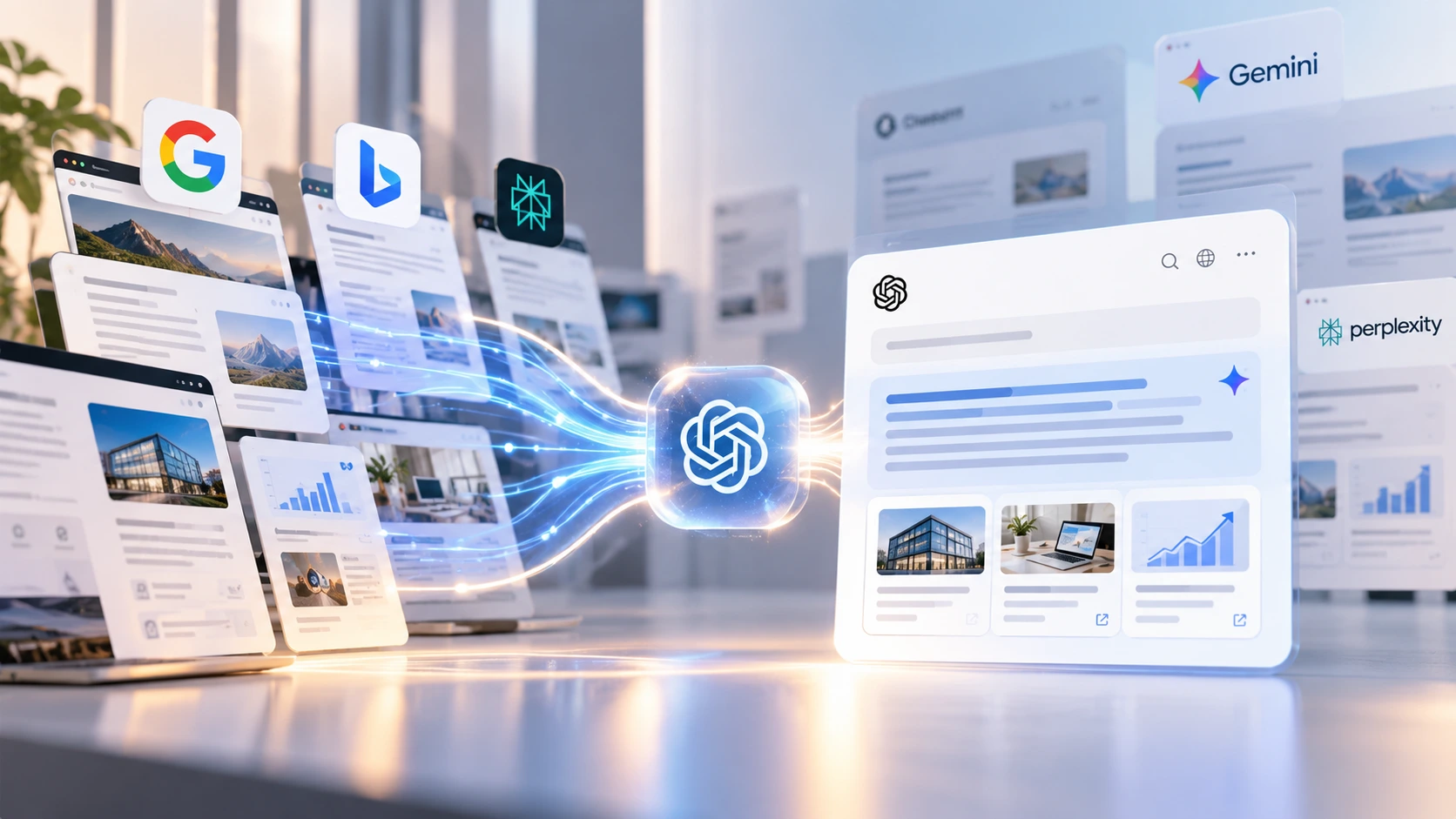
Search optimization has entered a new era. Businesses no longer want to appear only in Google's organic results — they also want to show up in the answers of ChatGPT, Gemini, Perplexity, and other AI-powered search engines.
When someone asks ChatGPT, "Which CRM system is recommended for a small business?" or "What AI chatbot should I use in an online store?", the AI can mention specific services, businesses, and websites.
But how do you get your business included among them?
In this article, we explain what GEO is, how AI-based search works, and what steps you can take to improve your business's visibility in 2026.
What is GEO, and how does it differ from traditional SEO?
GEO (Generative Engine Optimization) is a content and technical optimization approach aimed at making a website's information easier to find, interpret, and use for AI-based search systems.
Traditional SEO primarily targets visibility in search engines' organic results. GEO also focuses on appearing in AI-generated answers.
The two areas, however, are closely connected.
| Traditional SEO | GEO |
|---|---|
| Organic search visibility | Visibility in AI-generated answers |
| Keywords and search intent | Questions, topics, and relationships |
| Crawlable website structure | Clear, easily interpretable content |
| Backlinks and authority | Verifiable information and professional credibility |
| Organic click measurement | AI citations, mentions, and click-through analysis |
An important distinction: GEO is not a separate technical trick. According to Google's official guidance, traditional SEO principles continue to guide AI-based search functions.
How does ChatGPT find websites?
ChatGPT may use web search for certain questions to find current information and cite sources in its answers.
In such cases, the system can search for relevant websites, interpret their content, and reference them as sources in the answer.
This does not mean that every question triggers a web search, or that every relevant business appears in the answer.
ChatGPT's search function uses a web crawler called OAI-SearchBot. If a website blocks this bot, it may limit the content's appearance in ChatGPT's search answers.
Website crawlability is therefore a technical issue, not just a matter of wording.
1. Make your website technically accessible to AI crawlers
Even the best blog post cannot support search visibility if crawlers cannot access it.
It is worth checking the following:
- Are important pages accessible to crawlers?
- Does robots.txt accidentally block necessary crawling?
- Does the website content appear in crawlable HTML?
- Are important subpages included in the XML sitemap?
- Are canonical URLs correct?
- Do the server and security system block relevant bots?
For JavaScript-based websites, it is especially important to verify that the content is actually crawlable.
The fundamentals of technical SEO apply to GEO as well.
2. Answer specific questions in your content
When using AI-based search, people often ask full questions.
For example:
- "Which CRM system should a small business choose?"
- "How does AI customer service work in an online store?"
- "How much does a marketing automation system cost?"
- "What are the benefits of an AI phone assistant?"
This is why it is worth creating blog posts that address one specific problem at a time.
A well-written article gives a brief answer to the main question in the introduction, then details the options, benefits, limitations, and practical examples.
Not every heading needs to be phrased as a question. The key is that the content genuinely answers the reader's search intent.
3. Use clear headings and well-structured content
A logical content structure helps both readers and search systems.
In an SEO- and GEO-aware blog post, it is worth using:
- A clear H1 main heading.
- Logically structured H2 and H3 subheadings.
- Brief definitions.
- Practical examples.
- Comparison tables when genuinely useful.
- Frequently asked questions and answers.
For example, in an article about AI customer service, a separate section can show how an AI chatbot works, what data it uses, how it connects to the CRM system, and when human intervention is needed.
A clear structure makes relevant information easier to find, but by itself does not guarantee AI citations.
4. Build professional credibility with real case studies
One of the most important content differences between a generic AI-generated article and professionally valuable business content is firsthand experience.
A business can share truly unique information when it shows how it solved a specific customer problem.
Among Sales Innovo's references, for example, there are projects where CRM, AI customer service, and marketing automation are connected to measurable results.
In the Finnshop case, sales automations are linked to nearly 5 million forints in profit from the project's outcomes.
In Polcz Food's six-language online store, AI Chat, automated review collection, and customer communication support operations. According to the presented case study, 800 customer reviews were collected in six months.
This information is valuable because it relates to specific businesses, applied solutions, and results.
When presenting case studies, it is important to state the time period of the results, the measurement method, and supporting evidence where possible.
5. Make it clear who stands behind the website
In AI-based search, it is also important that reliable, consistent information about a business is available.
A detailed About page is useful for this, showing:
- The business name and activity.
- The founder and professional team.
- Relevant experience and areas of expertise.
- Real customer references.
- Participation in professional events.
- Verifiable partner relationships.
In Sales Innovo's case, for example, presenting the professional background connected to CRM systems, artificial intelligence, and marketing automation helps position the business clearly.
The goal is not to have as many flashy claims as possible, but to ensure that accurate, verifiable, and consistent information about the business is available.
6. Link blog posts to service pages
Internal linking is a fundamental element of traditional SEO and is also useful from an AI search perspective.
If a blog post explains how marketing automation works, for example, it is worth naturally referencing the related CRM and automation services.
From an article about AI chatbots, it makes sense to link to the detailed AI customer service solutions.
This way, search systems and readers can more easily recognize how the different topics connect.
In Sales Innovo's case, the following content can build on each other:
- CRM selection guide and Sales Innovo App.
- Articles about AI chatbots and Sales Innovo AI.
- Marketing automation guides and CRM features.
- Articles about customer reviews and real case studies.
Internal link text should be natural and accurately describe the linked page's topic.
7. Use structured data, but don't expect magic
Schema.org structured data can help search engines interpret website information more clearly.
For a blog post, the BlogPosting or Article schema can be useful.
These can specify the article title, author, publication date, and modification time.
For business presentation, the Organization structured data is also relevant.
However, according to Google, there is no need for special, AI-only structured data. Existing SEO recommendations and markup consistent with actual content form the foundation.
8. Don't optimize only for ChatGPT
Besides ChatGPT, other AI-based search interfaces are also important.
Google AI Overviews and AI Mode build on Google's search infrastructure, while Microsoft Copilot's search experience is closely tied to the Bing system.
Perplexity also compiles answers citing web sources.
Each system's operation and source selection may differ, so it is not worth focusing exclusively on one platform.
The best long-term approach is the combination of a technically accessible website, original professional content, verifiable information, and consistent online presence.
9. Measure visitors from AI search
GEO optimization results cannot be judged solely by traditional Google rankings.
It is worth monitoring referral traffic from AI-based systems as well.
With Google Analytics 4, for example, you can separately examine known referral sources related to ChatGPT, Perplexity, or other AI platforms.
It is also worth regularly checking whether the business appears in relevant AI answers for its field.
However, note that AI answers can change, and not every appearance results in a click or measurable visit.
10. Avoid GEO myths
With the popularity of AI search optimization, many exaggerated claims have also appeared.
For example, that adding certain keywords or special files guarantees inclusion in ChatGPT's recommendations.
This is not how it works.
There is no universally accepted method that guarantees an AI system will recommend a particular business for every relevant question.
Mass-generated mentions, keyword stuffing, volume-produced articles with no added value, and misleading claims do not represent a reliable long-term strategy.
The goal of GEO is not to manipulate AI systems, but to ensure that the business's genuinely useful information is easily accessible and interpretable.
How to start with GEO optimization?
If you want to improve your business's visibility in AI-based search, it is worth first examining your existing website.
Check whether your services are clearly presented on the site, whether important content is crawlable, whether you have professionally valuable blog posts, and whether you present real customer references.
Then it is worth creating new content on topics that answer your target audience's actual questions.
In the CRM, marketing automation, and AI customer service space, practical guides, comparisons, pricing articles, and concrete case studies are particularly useful.
Sales Innovo CRM and AI solutions help with customer communication, sales, and marketing automation. With the right system, lead management, campaigns, and customer data can be connected on a single platform.