
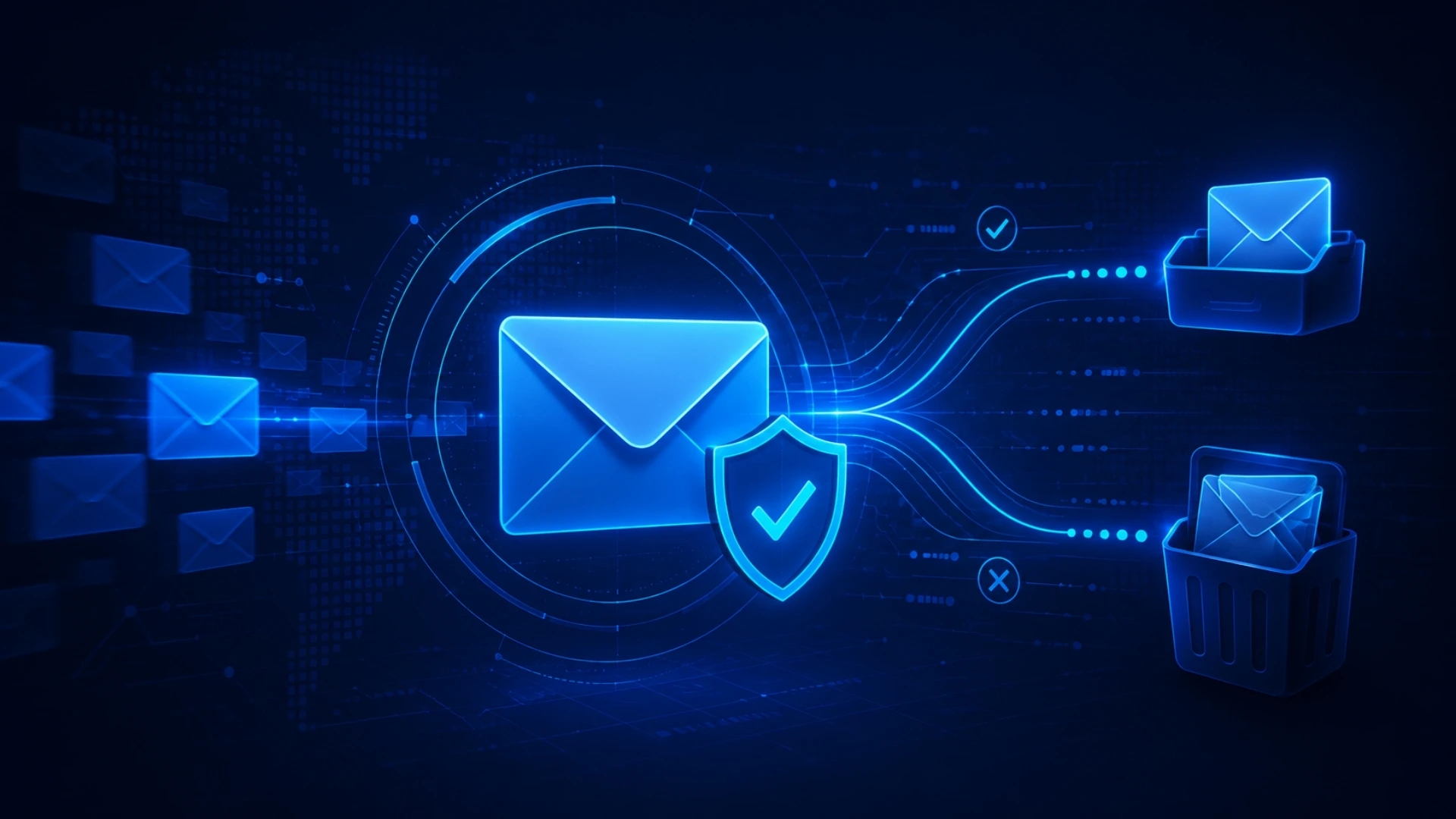
Newsletter marketing is still one of the most effective online marketing tools. Numerous studies show that, used properly, email marketing can deliver an outstanding return for businesses. Yet many companies experience that the open rate of their newsletters keeps declining, clicks are missing, and sales do not bring the expected results.
What could be behind this?
One of the most common problems is that the newsletters simply do not reach the recipients' primary inboxes. Instead, they land in the spam or promotions folder, where a significant share of users never encounter them.
In this article we show why a newsletter ends up in spam, how email deliverability works, and what you can do to make sure your emails actually reach your potential customers.
What is email deliverability?
Email deliverability means the rate at which sent emails arrive in the recipients' primary inboxes.
Many people think that if an email is successfully sent, it has reached its destination. This is far from that simple. Providers such as Gmail, Outlook or Yahoo examine the reliability of every single message based on hundreds of factors.
They take into account, among other things, the authenticity of the sending domain, the sender reputation, the email content, the open and click rates, the quality of the email lists, user feedback and the technical settings. If several of these factors are problematic, the email can easily end up in the spam folder.
The most common reasons your newsletter ends up in spam
1. Your domain is not properly authenticated
Email providers first check whether you actually sent the given message. They use different authentication methods that make it possible to verify whether the sender is trustworthy. If these are missing or misconfigured, email deliverability drops significantly. A poorly configured domain is like a stranger knocking on your door without identification.
2. Your sender reputation is weak
Email providers keep a score for every sender. If users regularly delete your emails, mark them as spam, or simply do not open them, it will negatively affect your reputation. A bad sender reputation is one of the most common reasons newsletters are not delivered properly.
3. You use an outdated email list
Many businesses collect email addresses for years but never clean their database. The result: inactive users, defunct email addresses, typos and spam traps. A low-quality email list not only hurts campaign performance but can also jeopardize the entire sending infrastructure in the long run.
4. You use too many images
Although visually appealing newsletters look good, excessive image use can cause problems. Spam filters find emails that consist almost entirely of images, with little text or large file sizes, particularly suspicious. A general recommendation is to strike a proper balance between text and images.
5. There are too many links in the email
A newsletter naturally needs CTAs and references, but too many links can increase the spam score. Shortened URLs, links to suspicious domains, too many external references and untraceable redirects can be especially problematic. Less is often more.
6. You overdo the formatting
ALL CAPS headlines, colored letters, too many emojis and overly aggressive marketing copy can still negatively affect email deliverability today. Expressions like 'FREE!!!', 'CLICK NOW!', 'GUARANTEED PRIZE!' or '100% SURE!' can be particularly sensitive. On their own these do not necessarily send an email to spam, but combined with several problematic factors they can pose a significant risk.
How has email marketing changed by 2026?
Email marketing today is much more of a technological question than it was a few years ago. AI-based spam filters are becoming smarter and continuously learn from user behavior. They examine whether people open the email, respond to it, forward it, or delete it immediately.
As a result, the success of a modern email campaign no longer depends only on good copywriting, but also on domain authentication, email infrastructure, server-side settings, list hygiene, sending frequency, sender reputation and content optimization. Businesses that ignore these factors find it increasingly difficult to run effective email marketing campaigns.
What can you do to avoid landing in spam?
The following steps can significantly improve email deliverability: verify your domain authentication, clean your email list regularly, use a balanced text-to-image ratio, reduce the number of unnecessary links, avoid overly aggressive marketing language, monitor open and click rates, perform regular email audits, and use a dedicated sending domain for larger volumes.
Summary
If your newsletters are not performing well, do not necessarily blame your copywriter or marketer. It may well be that the problem is caused by technical factors in the background. Email marketing in 2026 is no longer just about pressing the 'Send' button. Success requires the right technical background, a clean database, a good sender reputation and continuous optimization.
If you want to find out whether your newsletters actually reach your customers, the Sales Innovo team can help assess your current email system and recommend the necessary improvements. Because even the best newsletter is not worth much if no one reads it.