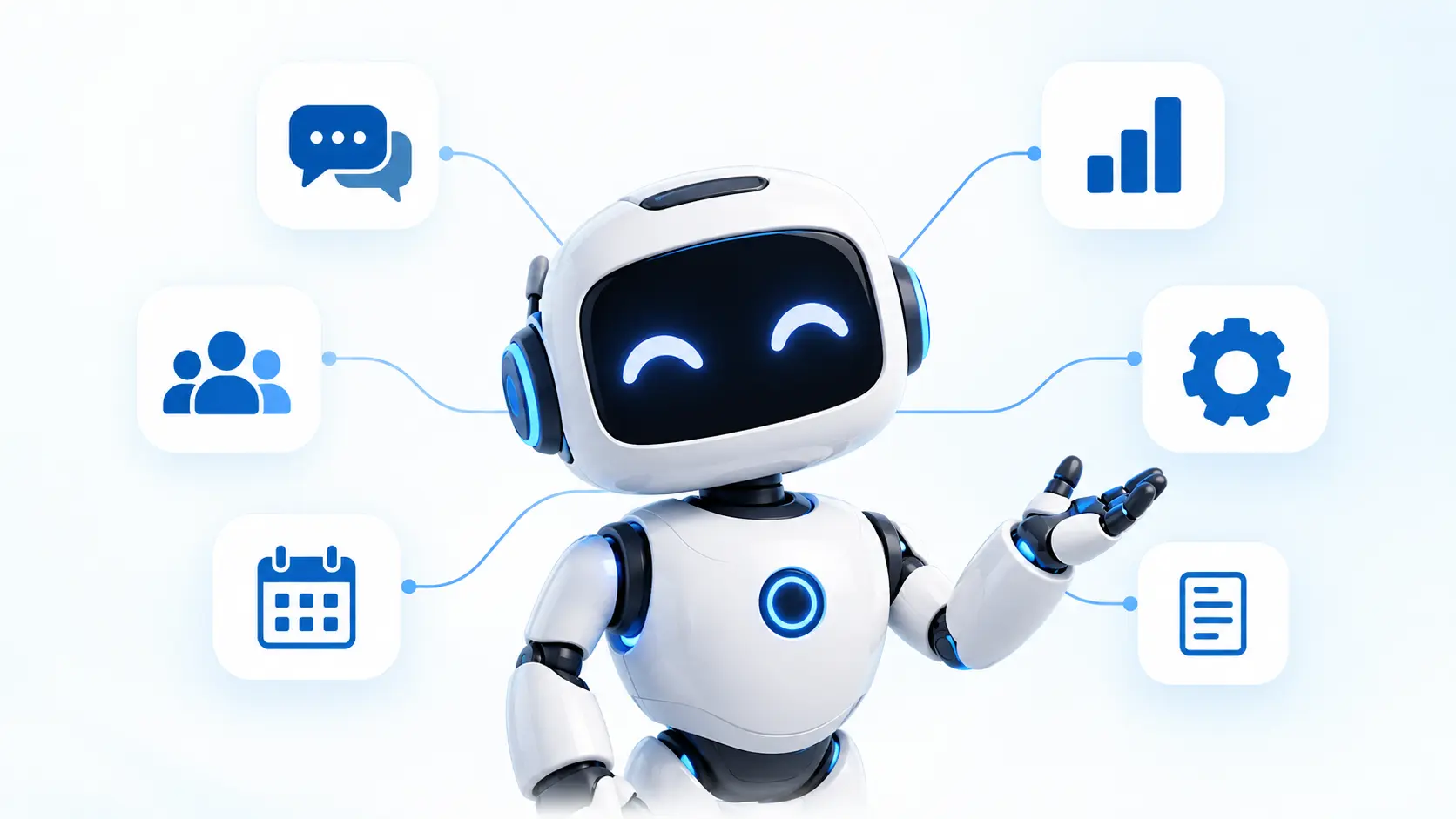
AI agents are software systems based on artificial intelligence that, in order to achieve a defined goal, can process information, determine decisions or steps, use tools, and execute tasks. An AI agent therefore does not necessarily just answer a question: with the right system connections, it can be an active participant in a business process.
In an enterprise environment, AI agents can be used, among other things, for customer communication, sales, marketing, appointment booking, data processing, administration, and supporting various automated workflows.
In short: an AI agent is an AI-based system that, in order to achieve a defined goal, can process information, determine decision steps, use tools, and execute tasks.
This is one of the most important differences between a simple generative AI chat and an AI agent integrated into a business process.
What is an AI agent?
An AI agent is a software system that, based on the information and instructions available to it, strives to achieve a defined goal.
The operation of an AI agent can consist of several steps, depending on the implementation: it receives information or an event; interprets the current situation; determines the next necessary step; uses one or more available tools if needed; executes an action; processes the result; and then continues the process until the defined goal is reached or human intervention is requested.
Behind an AI agent, there is often a collaboration of a large language model (LLM), business rules, data sources, APIs, and various software tools.
An AI agent therefore does not represent a single technology, but a system architecture in which artificial intelligence can handle tasks and operations as well.
What is the difference between an AI agent and traditional automation?
Traditional automation typically follows predefined rules. For example: if a lead fills out the form, send them an email, then notify the sales rep. The steps of the process are determined in advance.
An AI-based system, by contrast, can interpret unstructured information and, based on the content of the information, can choose different next steps. For example, a lead writes: "We have a 15-person sales team and are looking for a solution that automatically handles lead follow-up." The AI can recognize that this is a sales inquiry, extract the relevant information, categorize the lead appropriately, answer the question, forward data to the CRM, and launch an appropriate workflow — provided these actions are available to it in the given system.
The two technologies are not opponents. AI agents and traditional workflow automation can be especially effective together.
What is the difference between an AI agent and an AI chatbot?
The primary task of an AI chatbot is usually to have a conversation with the user. An AI agent can have a broader scope of tasks.
A chatbot, for example, can answer: "When are you open?" An AI agent with access to the right systems, in the case of a more complex request, can perform several actions: "I would like to book an appointment for next Tuesday." In this case, the system can, for example, check available time slots, ask for the missing data, create the booking, update the customer data, and launch the related confirmation process.
It is important, however, that not every AI chatbot is an AI agent, and not every AI agent is a chatbot. An AI agent can also operate in the background, without direct user conversation.
What is the difference between an AI agent and an AI assistant?
An AI assistant typically supports the user in completing a task. It creates text, searches for information, summarizes, brainstorm, or makes suggestions. An AI agent, by contrast — with the right permissions and integrations — can also execute actions on behalf of the user or the business.
There is not always a sharp technical boundary between the two categories. A modern AI assistant can also have agent-like capabilities. Therefore, when evaluating a business AI solution, the name itself is not what matters, but rather: what data it has access to, what tools it can use, what actions it can perform, what decisions it can make autonomously, when it requests human approval, and how its actions can be logged and audited.
How does an AI agent work?
The operation of a business AI agent, in simplified terms, can be described as the following process: goal → information → interpretation → decision step → tool use → action → result → next step.
Let's say a business's goal is to handle new leads faster. A website message arrives: "I'm interested in AI phone customer service. We have about 150 calls a day." The AI system can recognize the subject of the inquiry, identify the Voice AI topic and the given call volume.
Then — depending on the implemented process — for example, it can answer the lead's basic questions, ask for more information, record or update the contact in the CRM, tag the lead, place it in the appropriate sales pipeline, notify the sales rep, initiate appointment booking, or launch a follow-up workflow.
The AI thus does not operate on its own: the CRM, the automations, the data sources, and the integrations together form a business system.
What can AI agents be used for in a business?
The use cases of AI agents depend on what data, systems, and actions they have access to.
1. AI customer service
An AI agent can be used to handle frequently recurring customer questions, retrieve information, categorize problems, and forward more complex cases to the right team member. A well-built system must also know when it should not answer on its own and when a human agent needs to be involved.
2. Sales and lead management
An AI agent can support the first contact, qualification, and follow-up of leads. For example, it can recognize which service interests the lead, what problem they want to solve, what information they have already provided, whether further questions are needed, and which sales process it belongs to. With the right CRM integration, this information can be used directly in the sales process.
3. Appointment booking
An AI agent can recognize the intent to book an appointment during a conversation, ask for the necessary information, and — with the right calendar integration — help find a suitable time slot. Appointment booking can then trigger further automations, such as a confirmation and reminders.
4. Marketing
AI agents can also be used in marketing processes. They can help, among other things, with developing content ideas, creating marketing materials, analyzing information, segmenting leads, preparing personalized communication, and supporting campaign processes. For AI-generated content, human review remains important, especially for communication that is sensitive from a brand, legal, or professional perspective.
5. Phone communication
By combining voice-based AI and AI agent technology, phone processes can also be automated. A Voice AI solution, for example, can handle certain incoming calls, answer defined questions, collect data, or support an appointment booking process. The specific possibilities are always determined by the capabilities and integrations of the given Voice AI system.
6. Internal administration
AI agents are not only for customer-facing processes. They can also support internal tasks, such as gathering information, categorizing data, processing documents, creating summaries, or workflows between different systems.
What benefits can AI agents have?
The business benefit of AI agents is not simply that "the business uses AI." The real value comes from integration into the right process.
A properly built AI agent can help reduce repetitive manual tasks, respond to leads faster, make certain processes more consistent, handle some inquiries outside working hours, automatically structure incoming information, connect AI with the CRM and other business systems, and relieve the sales or customer service team.
The goal of an AI agent is not necessarily to fully replace humans. In many cases, a more effective approach is for AI to handle the recurring and well-defined tasks, while humans handle the complex, sensitive, or situations requiring larger business decisions.
What risks do AI agents have?
The more autonomous operation of an AI agent can also introduce new risks. The more systems and actions an AI has access to, the more important proper control becomes.
Special attention should be paid to data protection, access permissions, AI's incorrect answers, the possibility of faulty actions, handling sensitive data, logging actions, defining steps that require human approval, and regular testing and oversight of the system.
A good AI automation therefore defines not only what the AI can do, but also what it cannot do.
Do AI agents replace employees?
Not necessarily. The most obvious use cases for AI agents are tasks that are recurring, occur in large volumes, can be properly defined, and have enough data available to perform them.
A human team member can still be important, for example, when solving complex problems, in sensitive customer situations, for strategic decisions, handling exceptional cases, professional review, and creative and business decisions.
For many businesses, therefore, the most important question is not "what can AI replace?" but rather "which tasks are worth handing over to AI?"
Which tasks are worth automating with an AI agent?
A process can be a particularly good candidate for AI automation if it recurs frequently, requires significant manual work, consists of many similar decision situations, works with digital data, can be connected to other business systems, the expected result can be clearly defined, and exceptional cases can be forwarded to a human.
An AI agent is not the right solution for every problem. If a process is completely deterministic, a simple workflow automation is often a cheaper, faster, and more predictable solution. AI is worth involving where interpreting information, processing natural language, or more flexible decision logic provides a real advantage.
How to introduce an AI agent into a business?
The introduction of an AI agent should be planned starting from the business problem.
1. Define the problem
Do not start from "we want an AI agent." Instead, specify: "80 similar customer questions arrive every day, and answering them takes three working hours." This is already a measurable business problem.
2. Map the current process
Determine where the data comes from, what steps the team members perform, what systems they use, and where the bottlenecks are.
3. Define the AI's permissions
Decide what information it can read, what systems it can access, what actions it can perform, and which steps require human approval.
4. Connect the necessary systems
The business value of an AI agent can be significantly increased if it is properly connected, for example, to the CRM, the calendar, the communication channels, or other business applications.
5. Test in a controlled environment
Do not try it on the full customer traffic right away. Test the normal cases, the rare cases, the faulty data, and the situations when the AI has to forward the task to a human.
6. Measure the results
After implementation, it is worth examining metrics such as response time, the proportion of automated tasks, the proportion of cases forwarded to humans, the number of errors, the working time saved, the conversion rate, and customer satisfaction.
AI agents and Sales Innovo
Sales Innovo's goal is for AI to be usable not as an isolated tool, but connected to the business's customer management, communication, marketing, and sales processes.
AI-based solutions can be combined with CRM, automation workflows, and communication features, so the information processed by AI can become part of further business processes. Depending on the use case, such a solution can be, for example, Conversation AI, Voice AI, Ask AI, or AI Studio.
The right technology, however, should always be selected based on the business process and the goal to be achieved, not simply because a given solution is called an AI agent or artificial intelligence.
Modern business automation is therefore unlikely to consist exclusively of AI agents. An effective system combines deterministic automation, artificial intelligence, business data, and human control in the right places.